What Are Ginsenosides?
If you have seen ginseng on a label and wondered what separates one from another, the answer starts with ginsenosides.
What they are
Ginsenosides are naturally occurring steroidal saponins found in the root of Panax ginseng. They are the compounds that distinguish ginseng from any other root, and they are the reason it has held a central place in Korean and Chinese herbal medicine for over two thousand years.
Researchers have identified more than one hundred and fifty individual ginsenoside types. The most studied are grouped into two broad classes, commonly written as Rb1 and Rg1. A whole root preparation contains a spread of them, in the ratios the plant produced, rather than one isolated fraction.
Why root age changes the number
The plant concentrates ginsenosides in its root slowly, over years of growth, in response to soil conditions and seasonal cycles. This is the reason age matters so much in ginseng, and why it is the first question a serious buyer asks.
A two-year root and a six-year root are not the same material. Ginsenoside concentration rises with age and peaks around year six, before the root begins to decline. That is measurable chemistry, and it is why six years is the traditional harvest standard in Korean medicine rather than a marketing choice.
Why origin changes it too
Soil composition, temperature range and humidity all affect what the root builds. This is why Korean growers distinguish between regions, and why Ganghwa Island, Geumsan and the Goryeo region are not treated as interchangeable.
Ganghwa is a tidal island off the coast of Incheon. Centuries of tidal deposition have left the soil mineral dense, and ginseng grown there carries a different profile to root grown elsewhere in Korea. It is terroir in the ordinary sense.
What most labels do not tell you
Ginsenoside content drops with early harvest, poor soil, and high-heat processing. A product can list "Korean ginseng root extract" and contain a fraction of what a six-year root would carry.
Most labels do not give a ginsenoside percentage. Most do not give the root age. Most do not name the growing region. None of that is required by law in the United States, so it is legal to leave all three out.
The absence of that information does not prove a product is poor. But if a brand cannot answer those three questions when you ask, that tells you something about how they source.
What we can tell you
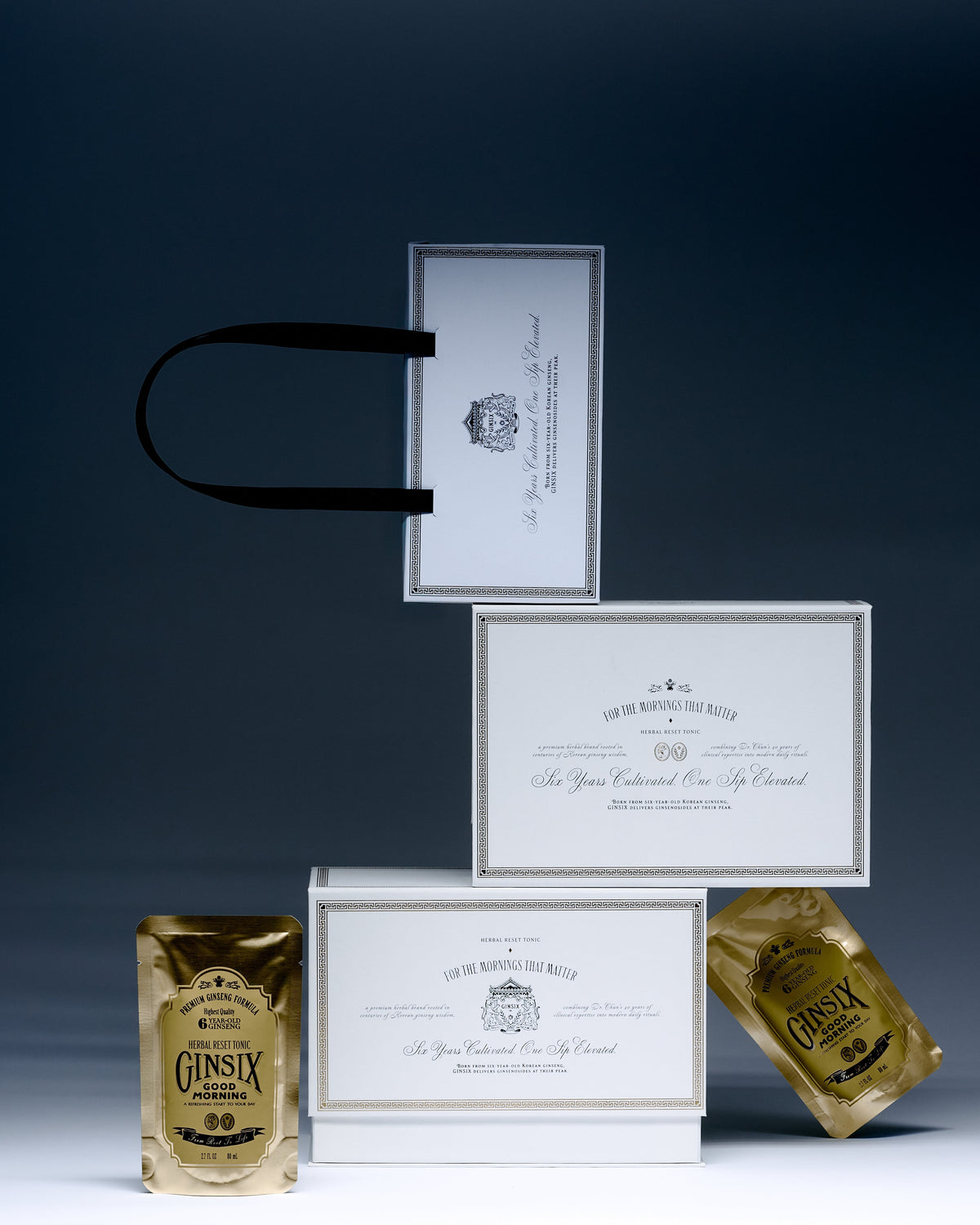
GINSIX Morning Ritual is built on six-year ginseng grown on Ganghwa Island, alongside ginger, kudzu, licorice, tangerine peel and malt. The formula was developed by Dr. Chun, who has practised Korean traditional medicine since 1987.
We name the root age. We name the island. We name the Doctor of Korean Medicine. Those are the three things a label can be held to.
GINSIX Morning Ritual is an 80mL Korean herbal tonic, sold in 3-, 6- and 12-packs. More on the formulator on the About page.
GINSIX is a herbal tonic, not a medicine. It is not intended to diagnose, treat, cure or prevent any disease. If you are pregnant, nursing, taking prescription medication, or managing a health condition, speak to a clinician before adding any herbal product to your routine.